
The importance of intergenerational digital education in the field of AI

By Łukasz Tomczyk
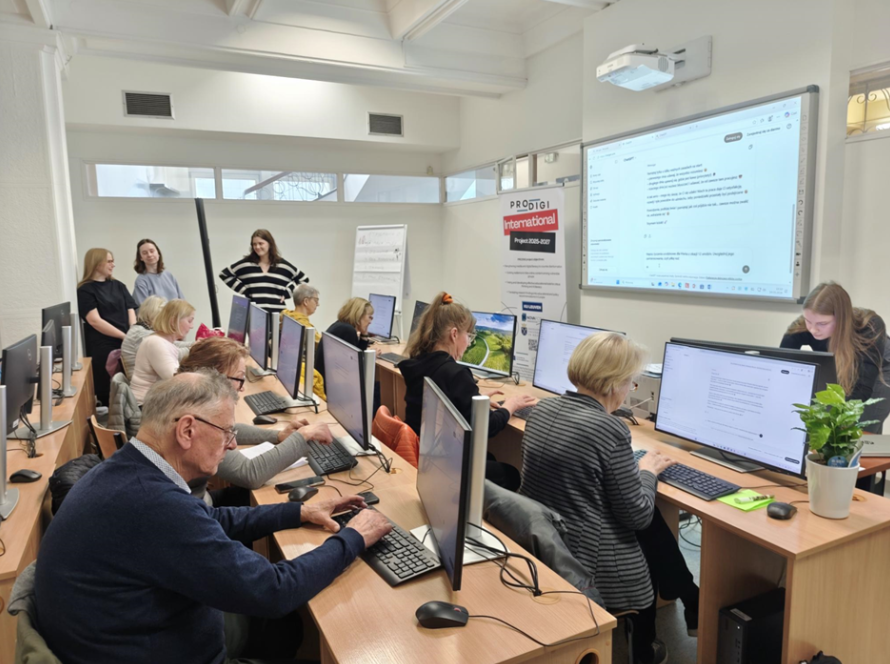
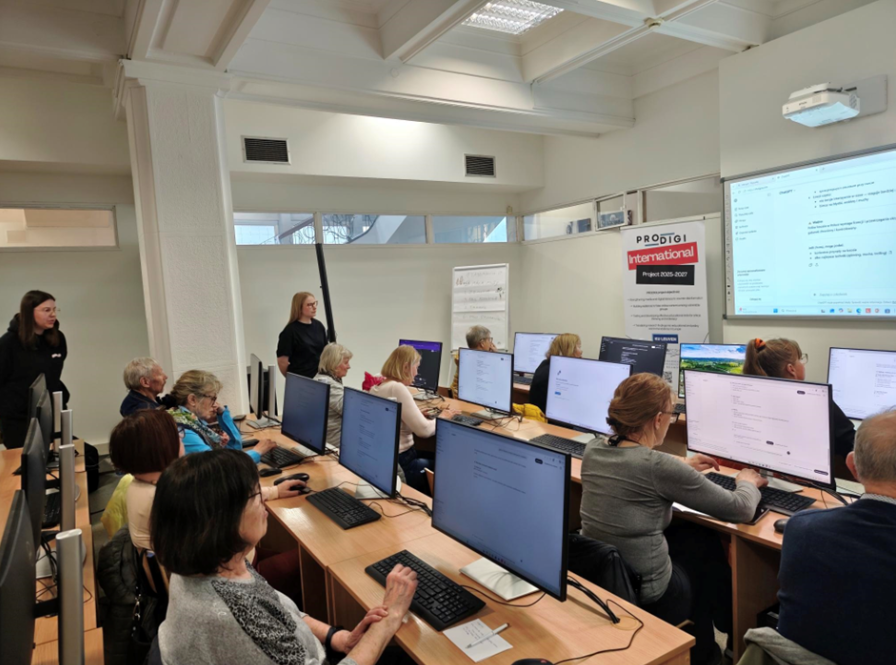
As part of the PRODIGI project, the Polish team organised training not only for older people from small towns, but also facilitated intergenerational interactions. These activities involved preparing students of pedagogy (Faculty of Philosophy, Jagiellonian University in Kraków) to take on the role of geragogues. The task was carried out in several stages and included both methodological preparation and practical work with older people wishing to learn the ins and outs of using AI. The PRODIGI project thus made it possible to move beyond existing models of training future teaching staff, directing geragogical interventions towards current issues – the challenges of the information society’s development – whilst also enabling future teachers to test their own teaching skills in a real, complex educational environment. During the course, younger participants acted as guides and support staff, whilst older participants had the opportunity to familiarise themselves with everyday digital life in line with the concept of intergenerational learning.
Responses collected after the first stage of the training show that participation in such activities was perceived as much more than simply learning how to use AI. In the respondents’ comments, technology sometimes takes a back seat, giving way to what happens between the participants; the focus thus shifts to issues such as relationships, getting to know one another, learning patience, and overcoming distance and stereotypes. The designed activities clearly demonstrate that both sides benefit from this. Seniors acquire new skills and greater self-confidence, whilst students gain experience that would be difficult to replace with academic theory alone.
An analysis of the comments gathered after the first training sessions led by students allows us to identify several distinct areas of benefit. These relate, firstly, to the seniors themselves and their ability to navigate the world of new technologies; secondly, to the development of students as future educators; thirdly, to intergenerational relationships; and fourthly, to the practical aspects of educational work, which require flexibility, attentiveness and a willingness to tackle real-world challenges.
Benefits for older adults of participating in AI-focused courses
The most obvious and frequently cited outcome of participating in the project is the benefits reaped by older people. In the responses from future teachers, there is a recurring belief that such sessions help older people better navigate a reality in which an increasing number of tasks are carried out online and using AI. This is not just about learning how to use devices or apps, but about something far more important: the feeling that one can be more independent, proactive and less dependent on others. For many older people, entering the world of new technologies can be difficult, as it involves a fear of making mistakes, the pace of change and the feeling that ‘this is no longer for me’ (this issue is very well explained by the theory of self-marginalisation). This makes it all the more significant that, in the statements analysed, technology is seen as a tool for inclusion rather than exclusion, which is the primary aim of the activities designed to improve quality of life.
An analysis of the trainers’ comments reveals that participants recognise not only the practical but also the emotional dimension of this process. Older people who acquire new skills may feel more confident, more at ease and simply better in a world that previously seemed too complicated to them. Several responses also mention the theme of being noticed, looked after and treated with care. This is a valuable observation because it shows that learning technology (in this case AI) in this context is not merely about imparting instructions, but also a form of social support. Thanks to this (taking part in projects similar to PRODIGI) can help reduce feelings of isolation and reinforce the belief that personal development in later life is still possible and necessary.
Developmental benefits for students
A second key area concerns the benefits that education students gain from participating in the project. In the comments of these future teachers, words such as patience, forbearance, empathy and understanding of others’ limitations recur very clearly. This is no coincidence. Working with older people in the field of new technologies requires more than just technical knowledge of AI or specific teaching methods (in this case, geragogy). It requires the ability to view the world from the perspective of someone for whom certain actions are not intuitive, and for whom the language of technology may sound alien. For many students, this was a reality check, where they had to slow down, simplify their explanations and set aside their own communication habits.
This experience is particularly significant for those preparing for a career in education. It demonstrates that teaching is not merely about imparting knowledge, but above all about adapting to the learner. In this sense, the PRODIGI project has become a form of pedagogical sensitivity training for the students. Some students explicitly note that this allowed them to assess whether they are suited to working with older people, whether they can fulfil the role of a teacher, and how they react to more challenging, also less predictable situations that fall outside all previously known patterns. Such experiences are particularly valuable because they allow academic preparation to be tested against a real-life educational situation, in which not everything can be planned in advance according to previously learnt theories.
Relational and social benefits
A very clear theme in the collected material is also the importance of intergenerational relationships. Many responses show that participants did not view these meetings merely as sessions about technology, but as an opportunity for two worlds to meet, worlds that do not always have the chance to get to know each other well in everyday life. It is precisely in this space that benefits emerge which are harder to measure but socially very significant, linked to building bonds, bridging the gap, greater openness towards the other age group, and mutual familiarisation with different ways of thinking.
It is particularly interesting that the theme of breaking down stereotypes frequently emerges in their comments. Students note that older people are not a homogeneous group - they differ in temperament, experience, level of knowledge and interests. Some even emphasise that meeting older people has allowed them to move away from simplistic notions about them. On the other hand, older people gain the opportunity to engage with the younger generation in a situation based not on distance, but on cooperation. As a result, technology becomes a starting point for something greater, so intergenerational dialogue, in which both sides can learn from one another. This is important because it shows that the value of such projects goes beyond the transfer of specific skills, their strength also lies in creating a shared social space.
Practical benefits and reflections on geragogical work
The final category of student comments, which serves as a concluding reflection on this stage of the project, concerns what participants learn about the educational work itself. Many of the comments contain very specific observations regarding teaching methods, such as the need to use simple language, read instructions aloud, explain things from the basics, allow time for tasks to be completed, and constantly adapt one’s response to the group’s level. This shows that participation in the project was not only a social experience but also practical pedagogical training. The students did not speak about teaching in abstract terms but described it through the prism of real actions, trials, adjustments and observations of what works and what must be changed in the future.
The responses are neither overly “polished” nor exclusively enthusiastic. They reveal an awareness that such work can be demanding, at times difficult, and even confrontational. Some participants note that engaging with this age group is not always easy due that it requires resilience to stress, flexibility, and a readiness to change plans whilst in action. It is precisely this honesty that makes the material gathered as part of PRODiGI particularly interesting. It shows that the value of the project emerging not only in the positive experience, but also in the opportunity to check the realities of working with older people. Sometimes, the benefit also lies in discovering one’s own limits, preferences and the specific group of people one actually wishes to work with in the future.
The statements gathered following the first phase of activities carried out under PRODiGI and in collaboration with local organisations working for the benefit of older people show that we are dealing with a multidimensional experience. This is not merely a project about technology, nor is it solely a form of assistance for older people who do not use AI. Rather, it is a space for mutual learning, where older people gain greater independence and self-confidence, whilst students develop skills that cannot be acquired solely in the lecture hall. At the same time, self-awareness is built, stereotypes are broken down, and a more attentive view of other people’s needs emerges.
Perhaps the most interesting aspect of this material is that new technologies are not the most important thing here in and of themselves. They become a pretext for meeting, collaborating and learning from one another. And this means that the value of such activities extends far beyond the purely practical dimension, also concerning the way in which a more inclusive, open and supportive community is built.
Krakow, April 2026
Łukasz Tomczyk, Professor, Jagiellonian University
Institute of Pedagogy


Opmerkingen