
A Smart Mind: AI in the Context of Senior Citizens’ Education. How older adults are coming to terms with artificial intelligence

Artificial intelligence has very quickly become one of the most frequently mentioned topics of our time. It is discussed by the media, schools, universities, tech companies and politicians. For many older people AI remains something vague, distant, and sometimes even intimidating. They know everyone is talking about it, but they don’t always know where to look for this artificial intelligence, how to use it, or what it could actually be useful for in everyday life.
However, conversations with those running training courses for older people in Poland reveal something very important: AI only begins to make sense when it ceases to be an abstract concept and becomes a practical tool. It is therefore not a question of starting with definitions, language models or technical explanations. It proves far more effective to show that artificial intelligence can help translate the text on a T-shirt, understand a letter from a government department, write a birthday message for a granddaughter, decipher an old recipe, plan a garden, or check whether an online message is a scam.
It is in situations like these that technology ceases to be alien. It becomes something familiar, useful and manageable.

Seniors don’t ask about algorithms. They ask directly: ‘How will this be useful to me?
One of the key findings from analysing training sessions in small Polish towns is that older people rarely arrive with very specific expectations, such as ‘I want to learn how to use a particular AI tool’. More often, there is a more fundamental need: they want to understand what artificial intelligence actually is and where it can be found.
It is only during the sessions that it becomes clear that AI can be present in tools they already have on their phones. It can help with translating texts, image search, creating simple graphics, editing messages or organising information. For many participants, this is a moment of discovery: artificial intelligence is not something confined to technology laboratories. You can literally have it in your pocket.
One of the most interesting observations concerns the way in which older people refer to AI themselves. Very simple but extremely apt terms emerge, such as ‘smart head’. From an educational perspective, this is very important. Such a name makes the technology more approachable. It allows people to talk about it in their own language, without fear of specialist terminology.
The best digital education starts with everyday life
AI training for older adults shows that effective digital education should not start with a computer programme, but with the participants’ lives. If someone have worries it’s worth showing them how to translate a pattern in a foreign language. If someone enjoys gardening - you can plan a flowerbed together. If someone cooks you can look up an old recipe or ask the AI for help when a cake doesn’t turn out right. If someone is bored by official letters from eg. Municipality or court you can show them how to translate bureaucratic language into something more understandable.
These are small situations, but it is precisely these that build a sense of agency. A senior doesn’t need to understand straight away how the AI model works. What’s more important is that they can use the tool to solve their own problem. Then technology ceases to be a demonstration of capabilities and becomes a support in everyday life.
Working on smartphones is also a very important part of these sessions. Many older people use their phones more often than a computer. Sometimes they use it mainly for making calls, Messenger or WhatsApp. The training shows them that the same phone can also be a translator, a camera, a notepad, a search engine, an assistant and a tool for conversing with AI. This is particularly important because education delivered on a device that the participant actually uses is more likely to translate into practical use at home.

There is no single, universal type of senior learner
Another very important conclusion is that there is no single, homogeneous group of seniors. Older people are extremely diverse. You work differently with participants at Universities of the Third Age, who are educationally active and accustomed to learning, than with people from small towns or rural areas, who have often had fewer opportunities for regular contact with technology.
Some older people are adept at using smartphones and quickly move on to discussing threats, disinformation or fake content generated by AI. Others start with much more basic barriers: they don’t know how to install an app, are afraid to click, can’t remember passwords, or fear they might break something or accidentally pay for something.
This shows that artificial intelligence does not create digital exclusion from scratch. Rather, it exposes pre-existing inequalities. If someone has been outside the world of digital technology for years, entering the world of AI can be particularly difficult for them. That is why training must be calm, practical, patient and closely tailored to the participants’ level.
Fear is just as important as a lack of skills
When working with older people, the obstacle is not solely a lack of knowledge. Often just as strong is the fear of breaking the phone, deleting something important, losing money, clicking in the wrong place, giving out personal details or installing a dangerous app. Added to this are manual difficulties: double-clicking, selecting text, taking a photo, switching between apps.
This is why trainers play a special role. They are not merely people imparting knowledge. They are interpreters of technology, facilitators, guides and people who help to reduce tension. Sometimes the best method is not a lecture, but a relaxed exercise, a joke, an anecdote, working in pairs, or showing that you can give it a go and nothing bad will happen.
AI is also about security and resilience to fraud
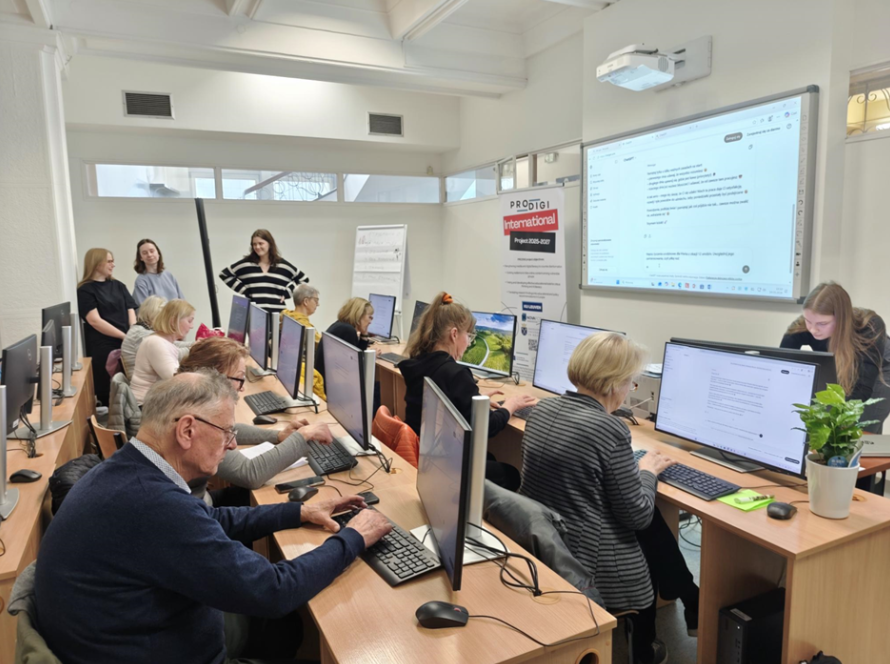
The training sessions delivered as part of the PRODIGI project do not focus solely on the positive applications of artificial intelligence. Digital security is also a key element. Older adults learn to recognise suspicious messages, analyse sources of information, check whether content found online is reliable, and understand how modern scams might work.
The workshop exercises, in which participants take on different roles, such as that of someone trying to extort money, are particularly valuable. This allows them to see the inner workings of a scam. Trainers also demonstrate that modern technologies can generate images, photographs or clone voices. Not to scare people but to increase knowledge and resilience to manipulation. This is particularly important because older people are often identified as a group vulnerable to misinformation and various forms of cyber fraud. AI education must therefore combine two objectives, so demonstrating the usefulness of technology whilst teaching caution.

How can we tell if the training is working?
The most interesting thing is that the effectiveness of the training isn’t just evident in knowledge tests. It’s seen above all in the little stories that participants bring back to subsequent sessions.
Someone wrote a birthday message for their granddaughter. Someone translated the slogans on T-shirts. Someone planned a flower bed in the garden. Someone used AI to reply to an official letter. Someone asked to have an app installed, even though they used to be afraid of their phone. Someone looked up a recipe or read a text that had previously been incomprehensible.
These are very concrete indicators of change. The senior citizen is starting to use technology outside the training room. They are not just hearing about AI, but starting to use it. They don’t have to use the correct terminology straight away. What matters is that the technology has been embraced and incorporated into everyday practices.
The most important thing is a sense of agency
From an educational perspective, the most important conclusion is simple – AI for older adults should be taught through practical application, not through technical marvels. It is not about convincing older people that they must use every new app. Rather, it is about showing that they can use selected tools when they genuinely help them.
A well-designed AI training course does not begin with the question: “How does artificial intelligence work?”. It begins with the question: “What is important to you and how can technology help?”.
It is then that artificial intelligence ceases to be a buzzword and becomes a tool for enhancing the independence, safety and activity of older people. And sometimes, as they themselves emphasised, simply a ‘smart brain’ in a phone that helps them do something that until recently seemed out of reach.
Krakow, June 2026
Łukasz Tomczyk, Professor, Jagiellonian University
Institute of Pedagogy
![Between competence and uncertainty: students' [pre-service teachers] concerns about digital inclusion classes with older adults](https://static.wixstatic.com/media/7d40fa_131f1ab336784156944a89fdc81bb130~mv2.jpg/v1/fill/w_791,h_791,al_c,q_85,enc_avif,quality_auto/7d40fa_131f1ab336784156944a89fdc81bb130~mv2.jpg)
Opmerkingen