
How do older people learn to use artificial intelligence? Reflections following a series of training sessions in small towns

By Łukasz Tomczyk
2026/05/14
And now a few words about the training sessions led by professional trainers in the Małopolska Province. By way of introduction, it should be emphasised that the training programme implemented as part of the Polish edition of PRODIGI with senior citizens comprised seven sessions, each lasting two hours. The sessions were held mainly in rural areas and small towns, and thus in communities with their own distinct characteristics. These are not anonymous course groups, but often communities where participants have known each other for years, meeting in rural women’s clubs, retirement homes, universities of the third age or local organisations, including informal groups. Simply attending the sessions was therefore not only a typically educational activity, but also a social one, and thus an opportunity to meet, chat and explore together what this artificial intelligence is all about. The specific nature of working with older adults to develop digital skills is a highly complex subject, which is briefly outlined below. The following statements are examples from an interview conducted with the project’s trainers, namely Mariola Fik MA, and Marcin Zarzycki MA.
The programme followed the PRODIGI template, but practice showed that when working with older people, the scenario itself is merely a starting point for in-depth and appropriately implemented activities. A great deal depended on the group, their level of digital competence, their willingness to experiment, their apprehensions regarding technology, and the local context (small towns significantly vary in terms of how seniors use new media). From the outset, the trainers emphasised that they were working with a very diverse group of people, ranging from seniors who were adept at using smartphones to those who only had a landline or expressed a strong fear of computers and apps.

The most important conclusion from the trainers’ comments is, on the face of it, simple: older people learn best when they see a direct benefit in using new tools in their own lives. Artificial intelligence, image search, text translation or content generation only become interesting when they meet specific needs. That is why examples from everyday life worked very well, such as translating labels on clothes, recognising text on banners, reading recipes, working with old cookbooks, planning trips, writing birthday wishes for a granddaughter, reading official letters, or using materials related to hobbies. One situation illustrates this mechanism well. A participant in the sessions, who was crocheting, discovered that thanks to the translator and AI tools, she could understand patterns available in foreign languages. This was no longer about learning yet another computer application. It was the realisation that technology could help with something truly important to her personally. It is precisely such moments that build a sense of agency and bring satisfaction.

For many seniors taking part in the PRODIGI training sessions, artificial intelligence was not a specific tool, but rather a buzzword that crops up on television, the internet and in conversations. Participants often did not come with the expectation of ‘I want to learn how to use ChatGPT’ or ‘I want to generate images’. More often, they simply said they wanted to understand what AI is and where exactly it can be found. This is an important observation. In senior education, one cannot assume that participants immediately know what to ask. Sometimes it is only a specific exercise that shows them that a particular tool can be useful. Birthday wishes provided a good example. The seniors were first shown ordinary, generic wishes found online, and then compared them with wishes prepared by AI for a specific person: a friend, a granddaughter, someone who likes the mountains, flowers, cooking or smart shoes. That’s when artificial intelligence ceased to be an abstraction. It became a tool for personalisation and communication, and an everyday companion.

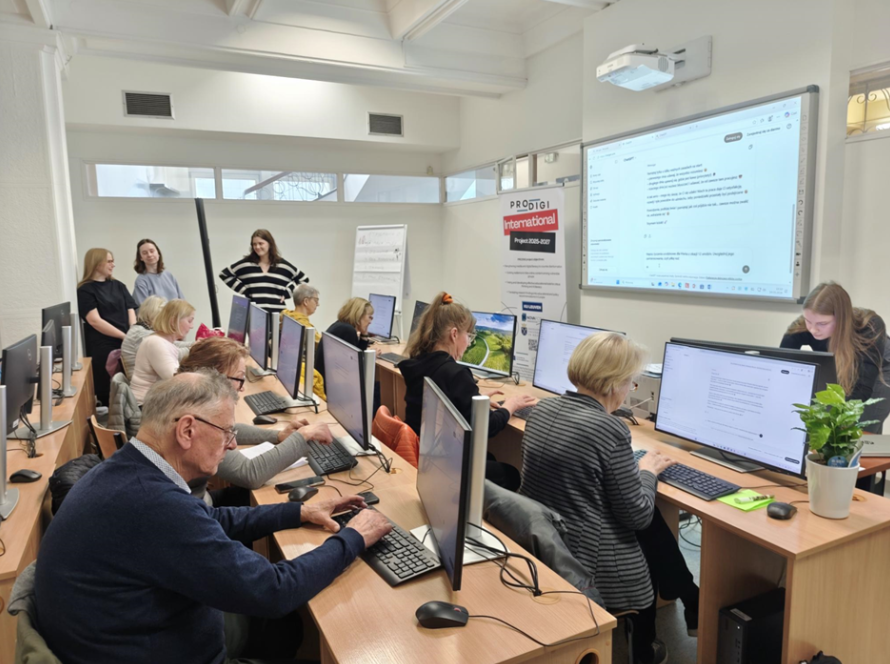
The issue of access to devices also came across very clearly. In many groups, it turned out that a computer is not a basic tool for older people. They use a smartphone more often, even if they mainly use it for making calls, Messenger, WhatsApp or browsing basic information. For this reason, trainers increasingly moved the exercises to phones. This was a more natural and practical solution. Seniors wanted to know how to do a particular task on their own device. Simply demonstrating a function on a computer was not enough if they were then unable to replicate it at home. This is an important consideration for the design of similar educational programmes. Digital education for older adults should not start with equipment that is convenient for the trainer, but with the equipment that the participant actually uses. Although it should also be emphasised that the mobile lab purchased as part of the project proved extremely helpful, particularly in the early stages of the course – in locations lacking full training infrastructure.
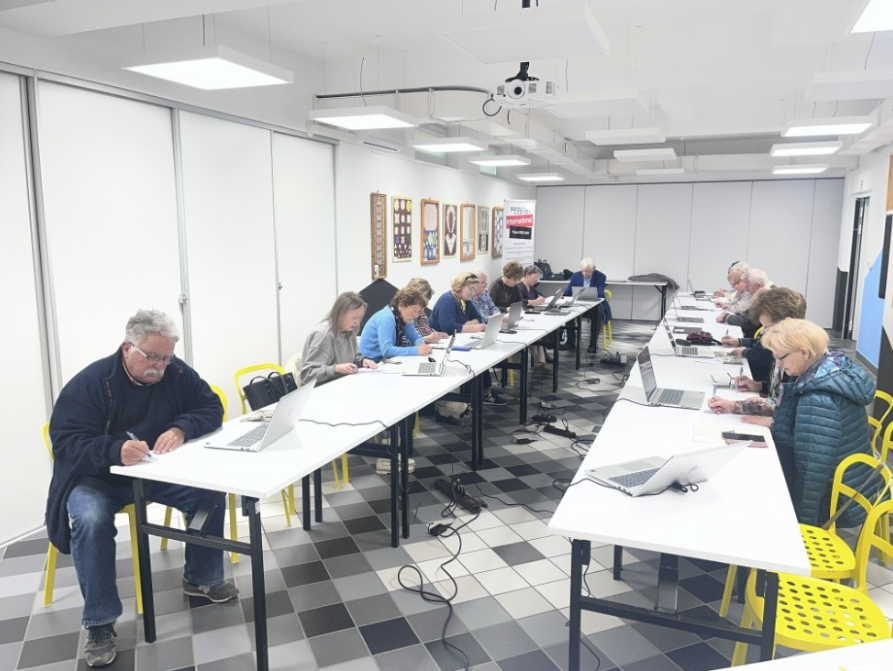
When working with older adults, sparking their interest proved crucial. Some groups arrived with considerable reservations. Concerns arose: “this isn’t for me”, “I can’t do this”, “I’ll break something”, “is there a charge?”, “is it safe?”. Therefore, the facilitators had to look for topics that would help overcome this initial resistance. Hence the ideas closely linked to everyday life: AI in the garden, online hairdressing, recipes, old photographs, family chronicles, trip planning, translating difficult texts, official documents, or photo editing apps. This content was not chosen at random as a mere attraction. It served a didactic purpose, helping participants engage with the subject without feeling intimidated, and directly linked to the project’s theoretical framework – namely, the relational model of digital competences.
The programme also placed significant emphasis on content relating to disinformation, fake news, online scams and fact-checking. The senior citizens learnt how to verify sources, consider why they might believe something to be true, how to confirm information, and what to watch out for in messages received via telephone, email or instant messaging apps. However, it was not the general warnings that proved most valuable, but the scenario-based exercises. For example, participants analysed the tactics used by fake couriers, attempts to extort money, suspicious charities and voice manipulation. They were also shown that voices can be cloned very quickly nowadays, which served as a good illustration of modern threats. As a result, the older adults didn’t just hear “be careful online”. They were able to see how manipulation works, what language fraudsters use, and which emotions they exploit.
Although the programme was based on the PRODIGI template, the trainers’ comments show that flexibility was necessary in practice. The groups differed in terms of skill level, experience, technological confidence and motivation. In one group, it was possible to move on to AI tools more quickly; in another, it was necessary to focus on the basics of using a telephone. It is also very important to note that older people often could not immediately articulate their needs. Not because they did not have any, but because they were not yet familiar with the possibilities of technology . It was only during the sessions that questions arose: can an old recipe be read, how to draft an official letter using AI, how to plan a trip, check information or share something with friends. That is why a good training programme for older people should have a structure, but it must not be too rigid. It must leave room for reaction, conversation, digression and working with what participants bring from their own lives.
The specific nature of rural areas and small towns also means that training is often not simply the implementation of a set teaching programme. It is a group gathering, an opportunity for conversation, the exchange of experiences and simply being together. This is particularly evident in groups linked to local organisations, rural women’s clubs or care homes. Therefore, the course content had to take the community dimension into account. Tasks that could be discussed together worked well, such as planning a trip, checking information, sharing found content, sending materials via messaging apps, and working in pairs or small groups. Technology then became a pretext for collaboration, rather than a solitary exercise at a device.

The trainers’ reflections following the completion of the seven-session cycle show that teaching older people to use artificial intelligence and new technologies requires a very practical approach. It is not enough to draw up a proper programme and prepare a list of AI tools with which the older people will be introduced. It is also necessary to find educational content that older people consider valuable. An important insight emerges from the trainers’ comments – examples related to everyday life worked best, specifically those concerning: family, the kitchen, the garden, health, documents, travel, crafts, photos, the local community and safety. It was these examples that helped overcome the fear of technology and showed that AI is not something distant, but can help with everyday matters.
It is also important to note that older people often do not start with pre-prepared questions. Needs only emerge once they see a specific application. That is why a programme based on the PRODIGI project works well when treated as a starting point rather than a rigid script. When working with older people, flexibility, patience, real-life examples and a willingness to follow the group’s lead are particularly important. In short, when it comes to developing digital and media literacy in the use of AI among older people, technology is important, but ultimately it is the content that determines whether the technology will be understood, needed and embraced in the long term.
Krakow, May 2026
Łukasz Tomczyk, Professor, Jagiellonian University
Institute of Pedagogy

Opmerkingen