
Empowering Future Educators: Insights from Our First PRODIGI Training in Poland

by Łukasz Tomczyk
2026/02/12
The first stage of the PRODIGI project in Poland (Jagiellonian University) included a training component aimed at students acting as young trainers (“pre-teachers,” digital natives), who then support older people in developing their media and digital skills. Recruitment covered people under 30 years of age, in particular social science students (pedagogical fields). An extensive preparatory program in media pedagogy and geragogy, focused on teaching seniors, was planned for this group. The classes in the first cycle were based not only on teaching methods, but also on problem-based learning (PBL) methodology. The project schedule assumed that at least 15 young trainers would be trained in the first phase of the project, and that the intervention would ultimately cover a larger number of people (these assumptions are being meticulously implemented). The results obtained in the first stage of the training are presented below. This stage focused on mapping the content of education related to the development of digital and media competences in the field of resistance to disinformation and AI use, so that it would be accessible and understandable to seniors and, above all, meet their needs.

A qualitative thematic analysis was conducted of fourteen statements made by education students participating in a course implemented as part of the PRODIGI project. The material consisted of open-ended answers to a question about the elements of the process of designing a teaching course on digital inclusion for seniors that the respondents found most difficult, along with explanations of these difficulties. An approach was adopted consisting of preliminary coding of the content, followed by grouping the codes into overarching problem categories; the co-occurrence of several themes within a single statement was allowed. As a result, a coherent picture of the dominant design barriers was obtained, covering both the level of goal and content selection, as well as didactic operationalization and the anticipation of psychological and organizational conditions for working with a senior group.
The collected data triggered a series of reflections on the methodology of teaching seniors in the field of ICT. The most frequently revealed area of difficulty was the selection of objectives and content that would be both genuinely useful for seniors, possible to present in an uncomplicated manner, and adequate for introducing complex topics. The students' statements point to a problem typical of educational design in conditions of limited knowledge about the audience (i.e., lack of work with this target group). On the one hand, there is a need to find a “starting point” – an issue that is not too obvious and at the same time not too demanding – and on the other hand, there is the difficulty of formulating a goal that “can be of real use to seniors.” Respondents participating in the training emphasize that it is necessary to mentally “step into the role of a senior” and anticipate what may be of practical value to them, which, in the absence of a systematic diagnosis of needs, becomes a task fraught with considerable uncertainty. As a result, course design appears not as a simple compilation of topics, but as a process of prioritizing and reducing (selecting, choosing) content, in which the key difficulty is deciding what is the content of first choice and what should be postponed or omitted.
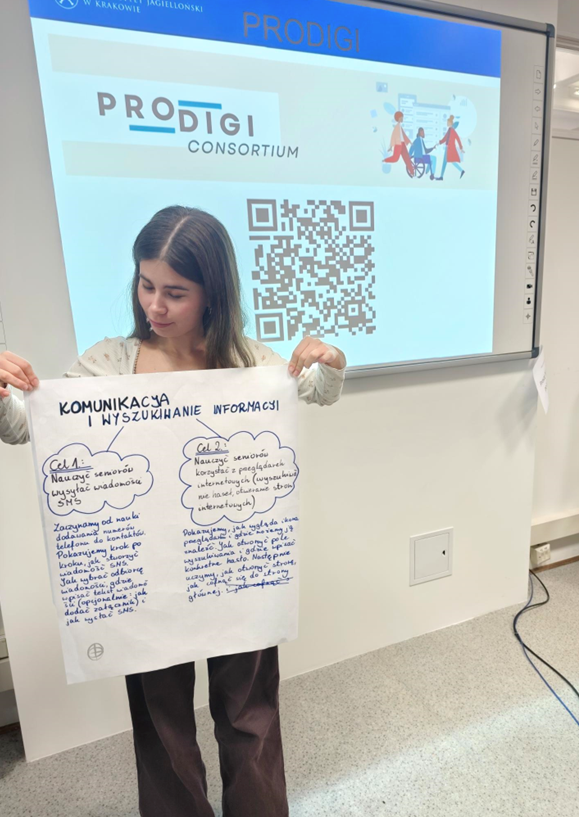
The second clear theme is the adaptation of teaching communication to the specific nature of older people's learning, especially in terms of language, clarity of instructions, and the degree of simplification of the message. Students describe the difficulty of “explaining in such a way that a person without any background knowledge understands what is going on,” while at the same time ensuring that the simplicity of the material is not perceived as infantilizing. This aspect requires a high degree of pedagogical sensitivity* - at this stage, students do not have much knowledge about the differences between pedagogy and geragogy. Nevertheless, they are able to intuitively notice that a person in late adulthood learning complex issues retains full subjectivity, and the course designer must organize the content in such a way as to reduce the cognitive load and eliminate IT jargon, without violating the dignity of the participant and without making them feel “treated like a child.” From a teaching perspective, this means that examples must be carefully selected, step-by-step instructions must be formulated, and messages supporting self-efficacy must be designed, which will be translated from ideas into practical actions in further stages of training and work with seniors.
Closely related to the above is the third topic: the heterogeneity of seniors' digital competences and the resulting need for preliminary diagnosis and individualization. Respondents clearly recognize that seniors “are not homogeneous.” This theme was emphasized in the theoretical introduction to the course by Prof. Łukasz Tomczyk, PhD, Eng., of the Jagiellonian University. One group may include people who are comfortable using smartphones, email, and other e-services, as well as those who are not sure “how to turn on a computer.” Without identifying the entry level, it is difficult to choose the pace of work, the scope of content, and the level of practical tasks. In turn adapting to each participant requires time and resources that the course designer or trainer often does not have in the conceptual phase - i.e., the phase preceding actual implementation. Therefore, the statements include a request for a preliminary diagnosis, as well as an awareness that even after the methods have been selected, it may be necessary to optimize them (e.g., in subsequent classes) and partially personalize them (i.e., select them according to skills or deficits) if the solutions do not prove to be so effective.
Another area of difficulty concerns the operationalization of content, i.e., translating issues into specific exercises, tasks, and working methods. Students point directly to the problem of “determining the content of an exercise for a given issue” and the difficulty of coming up with activities that are simple, meaningful, and appropriate for seniors. This is where the classic tension between the declarative level (what participants should know) and the procedural level (what participants should be able to do) becomes apparent. In teaching, i.e., the process of developing digital competences, it is the exercise component that is decisive, because only practice with appropriate support (instructions, modeling of the algorithm for performing individual activities, repetition, assisted work) translates into a sense of agency. The lack of ready-made exercise templates for this group and uncertainty as to how the tasks will be received in practice result in this element being identified as particularly challenging, which will probably be the case in subsequent stages of the training.
The material also clearly highlights a specific topic: the design of modules related to artificial intelligence. Students contrast AI with more intuitive topics, such as applications or internet security, emphasizing that AI is “more difficult to understand and explain well.” Some statements also include a self-diagnostic component: if the designer “does not use artificial intelligence themselves,” it is more difficult for them to design meaningful course elements based on real-world applications. In practice, this means that the AI module requires a particularly careful “didactic bridge” between concepts and the everyday situations of seniors, so that the content is not an abstract lecture, but is embedded in solvable and useful tasks. Therefore, the next part of the course will focus on translating the objectives into practical activities in which trainers test their own digital skills.
The next category of difficulties is implementation uncertainty resulting from limited experience in working with older people. Students point to the problem of predicting seniors' reactions and how they will approach tasks, which stems from a lack of professional contact with this group. This type of difficulty is practical and organizational in nature: an inexperienced course designer can plan the material, but the question remains whether the solutions will prove appropriate in a specific teaching situation, which in turn raises a number of questions: at what pace will participants work, where will obstacles arise, and what support will be necessary during the actual implementation of innovative measures concerning disinformation and manipulation. In this sense, design appears to be terra incognita, which requires verification in practice.

Finally, although less frequently, there are themes pointing to the psychological barriers of participants, such as fear of technology and low belief in their own abilities, as well as reflection on the lack of competence of the designers of such activities (in this case, students of pedagogy). In the first case, the students correctly note that the obstacle may be primarily emotional and motivational in nature, rather than strictly technical, and that there is no “universal remedy” for overcoming fears. In the second case, course design becomes a mirror revealing the competence deficits of the student themselves – the future teacher – which affects their confidence in selecting content and designing exercises. Both of these elements, although less numerous in the collected material, are of high interpretative importance, and thus indicate that the effectiveness of a modern course in digital inclusion depends not only on the substantive correctness of the content, but also on the quality of psychological support and the preparation of the instructors (in this case, the PRODGI project coordinator in Poland).
A synthesized picture of the responses leads to the conclusion that the greatest challenges for students lie at the intersection of three areas:
the accurate selection of objectives and content oriented towards the real needs of seniors;
the didactic transformation of this content into understandable, non-infantilizing communication;
the design of exercises that can be performed by people with very diverse competencies.
Against this background, the AI module emerges as particularly demanding, and the lack of experience in working with a senior group reinforces uncertainty about its implementation. Nevertheless, the material ultimately reveals the respondents' mature pedagogical intuition, exemplified by the design of a course for older adults that does not consist of a simple unification of content, but on responsibly balancing usefulness, accessibility, participant subjectivity, and the realities of implementation in a group with diverse abilities and different levels of digital and media competence.
Krakow, January 2026
Łukasz Tomczyk, Professor Jagiellonian University
Institute of Pedagogy



Opmerkingen